They Were Always Dressed

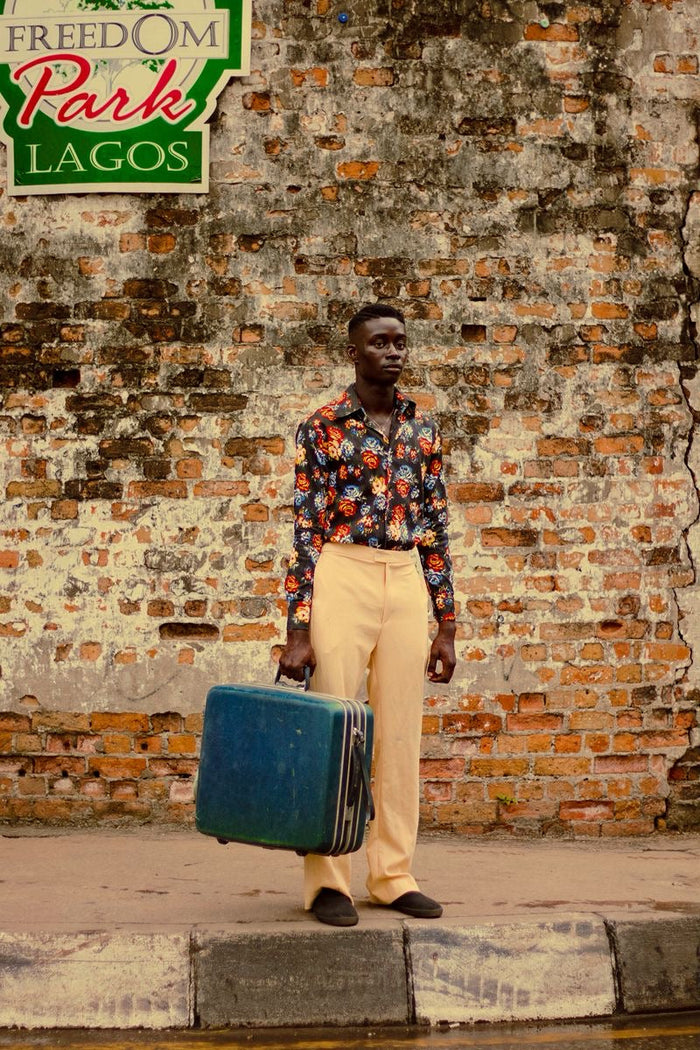
Stand outside Freedom Park long enough and you will understand something about this city that no trend report can teach you. The park sits on Broad Street on Lagos Island — built on what was once a colonial prison, now a performance space with a craft beer bar and a stage that rattles on weekends. But the real performance happens outside. A man stands against the aged brick wall, floral shirt tucked into cream wide-leg trousers, a blue vintage suitcase resting at his side. He is going nowhere in particular. He is dressed for everything.
That image — that posture — is Lagos in its truest form. Not Lagos as the world's media tends to frame it: chaotic megacity, twenty-two million people, traffic that makes grown men weep. Not Lagos as punchline or Lagos as cautionary tale. Lagos as a city that has always understood, at some cellular level, that how you dress is not vanity. It is vocabulary. It is the thing you say before you open your mouth.
The global fashion industry discovered Lagos around 2017. Designers flew in for Lagos Fashion Week. International publications ran shoots on the Lekki expressway. Bloggers called it "the next big thing." And Lagos, being Lagos, received all of this attention with the composed expression of someone who has heard this before.
Because they had. Lagos has been dressed for a very long time.
The Portrait
Consider this photograph: a young man, sometime in the early twentieth century, standing in a photographer's studio. Behind him, the painted backdrop that was standard in every studio from Lagos to London to Lagos again. He wears a three-piece pinstripe suit, waistcoat buttoned with precision, an ornate silk tie loose at the collar. On his head, a fez. On his feet, two-tone saddle shoes — black and white, the kind that required weekly polishing to keep that clean. He stands with his hands in his pockets. He is completely at ease.
 This is not a man performing wealth he does not have. This is a man who understands that a suit is an argument. Colonial Lagos was a city of navigators — people who moved between worlds, who dressed for the meeting they were heading into and the one they had just left. The Lagos merchant class of the 1800s and early 1900s were sophisticated consumers of cloth long before the word "consumer" existed in its modern sense. Aso-oke woven in Iseyin. Velvet from the Portuguese traders. George fabric brought by the British. All of it absorbed and rearranged into something distinctly Lagosian.
The tailors of Lagos Island — many operating out of shops along Bamgbose Street and Martins Street — were producing made-to-measure suits for local businessmen and politicians decades before any Western fashion house acknowledged that Africa had taste. The fez in this photograph is not an anomaly. It is a signature. Lagos has always mixed sources and made them entirely its own.
1979: The Year of Trousers
Independence came to Nigeria in 1960. What followed was a decade of political turbulence and cultural explosion that produced, among other things, Afrobeat, the oil boom, and some of the most remarkable trousers ever worn on the African continent.
By the late 1970s, Lagos was the wealthiest city in sub-Saharan Africa. Oil money had redrawn the city's geography — Victoria Island filling up with embassies and Lebanese merchants, Ikeja with its industrial estates, the old Island with its merchant families who had been there since before memory. And everyone, from the car mechanic to the civil servant to the university lecturer, understood that you dressed for the version of Lagos you wanted to be seen in.
 Two men, 1979. The date is written on the photograph in blue marker — a detail that makes the image feel like evidence. They stand in a garden or courtyard, green plants behind them. The taller man wears a red patterned shirt with a collar built for a different era — wide, pointed, almost architectural. His trousers are wide-leg plaid, falling to the floor in a single unbroken line. His companion wears an olive shirt, trousers that flare identically, and carries a brown leather briefcase as if he is late for a meeting that has not yet been invented.
These are not men who happened to get dressed. These are men who thought about it. The wide leg was global at the time — New York, Milan, London were all wearing it. But there is something specific about how it looks here: worn without irony, without self-consciousness, with the complete conviction that this is correct. That is the Lagos relationship with fashion. Not chasing. Belonging.
Lagos has never borrowed someone else's aesthetic and called it their own. They take what the world offers, run it through the city, and return it as something new.
The Nineties Kid
Ask anyone who grew up in Lagos in the 1990s what they remember about getting dressed, and they will tell you about church. Sunday morning was the weekly exhibition. Mothers ironed the same outfit three times. Fathers polished shoes that would only walk from the car park to the pew. Children were inspected before leaving the house and re-inspected at the church gate.
But the dress culture was not confined to Sunday. Lagos in the nineties was a city of hustle, of go-slow and generators, of boys in Surulere who watched American rap videos and then went to their local tailor on Monday morning and said: make me something like this, but not exactly like this.

Five young men. Dark background, like a studio photograph taken at a party or a night event. Each one in a different blazer: plaid, striped, yellow check, grey, floral. No two outfits are coordinated. All of them work. The man in the centre wears a yellow plaid jacket over a flowing blue fabric skirt — agbada-cut — and he has on tinted round glasses. He is not trying to be fashion-forward. He has no idea that word is being applied to him. He just knows what looks right.
This is the synthesis that Lagos produces without effort: Western tailoring codes married to Nigerian silhouette instincts. The blazer is European. The skirt is Yoruba. The combination is Lagos. No designer meeting was held to produce this. No mood board was consulted. It emerged from a city that has been processing multiple dress traditions for over a century and has never felt the need to separate them.
The New Archive
The Nostalgic Lagos project began as a document and became, without anyone quite planning it, a manifesto. Photographer and creative director Wale Adebisi started photographing the city as an act of memory. What resulted was something richer: a visual argument that the Lagos aesthetic tradition is not nostalgia but inheritance. That what the young men in the archive photographs understood, the young men in front of Adebisi's lens also understand.
 In one image, a man stands at a produce market wearing a green tweed suit — jacket and matching skirt — with white socks, black Oxford brogues, and red leather gloves. Around him: red peppers, sacks of yam, crates of citrus, a market woman adjusting her headtie. Nobody is looking at him twice. This is Lagos. The spectacular is not remarkable here because spectacular is the baseline.
The image does several things at once. It quotes the European country-house suit — tweed, the quintessential fabric of English landed gentry — and places it in the loudest possible context. It genders the silhouette ambiguously. It is completely still in a setting of complete motion. And it is, by any standard, an extraordinary photograph. Not because it is constructed — but because Lagos provided all the ingredients and they simply arrived.
This is what the Nostalgic Lagos images understand that trend reports miss: Lagos style is not about specific garments. It is about an orientation toward dress. A conviction that you show up fully, that getting dressed is not incidental to your day but the first decision you make about who you are in it.
The Blue Wall
The final image in this series is almost too composed to be accidental. Five people — three men standing, two women seated — arranged against a cobalt blue wall. The men wear tailored suits in cream pinstripe, grey herringbone, warm brown with a striped tie. The women sit in front, matching military caps, their legs extended with the casual authority of people who have nowhere to be and everywhere to be simultaneously. One woman has a monogrammed mule half on her foot. Nobody is smiling.
 This image looks like a fashion editorial because it is one — but it also looks like every group photograph taken in Lagos across the last hundred years. The composition, the suits, the formal posture softened by something unnameable: this is the Lagos portrait tradition. You dress, you stand, you let the camera see you. You have always done this.
The world calls it a moment. Lagos calls it Tuesday.
What It Means
There is a word in Yoruba — àṣà — that translates roughly as culture, tradition, the way things are done. It carries within it the idea that certain practices are not taught so much as inherited. You do not learn them from a book. You absorb them from watching your father knot his tie in a mirror, from the way your mother lays out an outfit the night before, from the collective agreement of a city that has decided, generation after generation, that appearance is not shallow.
XCLUSIVE exists in this tradition. Not as a museum of it — as a continuation. The belief that how you dress is a form of intelligence, that choosing your clothes carefully is not frivolous but foundational — that is not new in Lagos. It is very old. It survived colonialism, oil booms and oil busts, military governments and civilian governments, Instagram and the attention economy.
The man against the Freedom Park wall with his blue suitcase is not making a fashion statement. He is making the only statement Lagos has ever made.
We were always dressed. You just started looking.