Borrowed Colours
HOW CONTEMPORARY AFRICAN ART IS RESHAPING GLOBAL FASHION

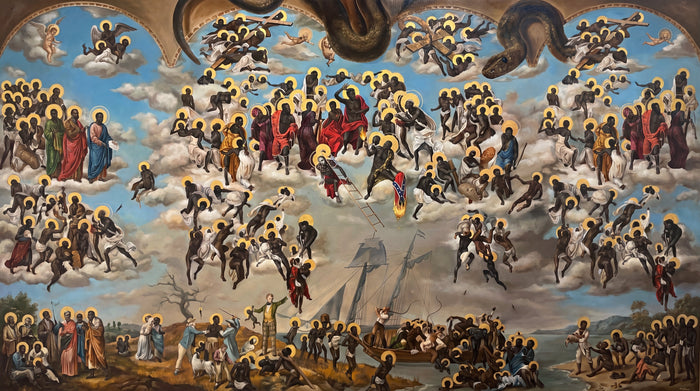
Look at the painting. Not quickly — look at it the way it demands to be looked at. Dozens of Black figures rise through a churning sky, each one ringed with a golden halo. Below them, a slave ship. A man in colonial dress stands on the shore, small, certain of himself. The figures above him are not rising to meet God. They are rising past him, through him, beyond him. This is not a painting about suffering. It is a painting about what survives suffering. And it is enormous.
This is what contemporary African art looks like when it decides to be ambitious on its own terms. Not the miniature, the decorative, the ethnographic curiosity. Not the "inspired by" credit buried in a fashion house's press notes. The full scale. The full argument. The full inheritance claimed.
For decades, fashion has called African art an "influence." Prints described as "tribal." Silhouettes called "African-inspired." Beadwork credited to a continent rather than a people. The language of influence keeps the source at a comfortable distance — grateful but anonymous, generative but marginal. What is happening now is something different. Contemporary African artists are not influencing fashion from a distance. They are leading the room.
The Vocabulary
Every visual language has a grammar. African beadwork — Yoruba, Kuba, Ndebele, Zulu — has one of the most sophisticated and rigorous visual grammars in the world. Geometric sequences that encode status, lineage, cosmology, ceremony. Cowrie shells pressed into patterns that speak across generations. Colours arranged not arbitrarily but according to systems developed over centuries of collective knowledge.
 When you see these objects in a gallery installation — arranged against a burnt orange wall, lit to throw their patterns into relief — you understand immediately that you are looking at a design language of extraordinary complexity. The diamond, the chevron, the face reduced to its essential geometry. Fashion has been quoting this language for decades. The endless parade of "tribal" editorial shoots that ran through every major fashion magazine from the nineties onward. The beaded gowns. The layered print collections credited to "global inspiration."
The difference now is attribution. And more than attribution — conversation. Designers like Kenneth Ize are not simply inspired by traditional Yoruba aso-oke weaving. They work with aso-oke weavers, commission specific patterns, bring the craftspeople into the credit line. Lisa Folawiyo built an entire design identity on the proposition that Ankara print is not a starting point but an arrival — complete, self-sufficient, international on its own terms. Thebe Magugu won the LVMH Prize while making clothes that are explicitly in dialogue with South African political history. The work is not trying to translate African art into fashion. It is insisting that African art already is fashion, already was, and always has been.
 These beaded panels speak the same visual language as the runway shows they eventually shape. The diamond repeat. The face reduced to two eyes and a mouth. The border that contains and defines the field. The colour logic — red against black, white against red — that is not decorative but informational. Look at them long enough and you will see them in the collections: not as quotation but as dialogue.
The New Sacred
Somewhere in the last decade, a specific visual mode emerged from African and Afro-diasporic artists: the sanctified archive. Vintage photographs of ordinary Black life — women at work, children in yards, elders at rest — layered with botanical illustration, crowned with halos, suffused with colour. The everyday made luminous. Labour made holy.
 Four women pound grain with wooden pestles. Each head is ringed with a golden circle — the same halo that appears in Renaissance altarpieces, in Byzantine mosaics, in every canonical image of the sacred in Western art history. The background is a wash of botanical illustration: plants, roots, the unseen life of the earth. The message is not subtle. It does not need to be. It is corrective. It says: this was always sacred. You simply were not looking.
This visual mode — archive photograph plus colour plus botanical plus halo — has become one of the defining aesthetics of the current moment. It appears in editorial shoots, on book covers, in fashion campaigns. Brands like Valentino, Gucci, and Bottega Veneta have all, at various moments, employed visual strategies that clearly reference this tradition. The question of who is leading and who is following has, for the first time, become genuinely unclear. The art is upstream of the fashion now. The galleries are setting the mood boards.
The Collage and the Diaspora
Mixed media collage has become the dominant form of contemporary Afro-diasporic art for a reason. Collage is the art form of the in-between. It holds contradiction. It places things that were never meant to be together in the same frame and forces you to look at what that creates.
One image: two women, one braiding the other's hair. The photograph is old — black and white, documentary, the kind taken by someone who did not think they were making art. Over it, tropical leaves in green and blue, drawn and layered like a second skin. In the corner, poetry in Portuguese: Mil nações / Moldaram minha cara / Minha voz / Uso pra dizer o que se cala. A thousand nations shaped my face. My voice I use to say what is silenced.
This is diaspora aesthetics at its most precise. The hair braiding — intimate, practised, passed down through hands — as the anchor. The botanical overlay — nature as homeland, as memory, as the thing that grows back. The poetry in a colonial language repurposed for something else entirely. And all of it together: not chaos but composition. Not confusion but absolute clarity about what it means to carry multiple histories in one body.
Fashion has been trying to express this exact feeling for years. The braided runway looks. The mixing of heritage print with contemporary silhouette. The casting calls that finally began to understand that a face can hold more than one geography. What African and diasporic artists articulate in collage, in paint, in beadwork — fashion is catching up to.
The Elder and the Transmission
There is a woman in white robes, her hands open, a white turban on her head. Behind her, heliconia flowers — the kind that grow across West Africa, across the Caribbean, in every place the diaspora carried its seeds. Above her, a gold circle: sun or halo, or both at once. She is an elder. She is a healer. She is holding something the image does not name but the viewer recognises immediately.
 And then there is the illustration: six women in white dresses, standing in a circle, their long braids intertwined and flowing between them like a river. Each one holds the braid of another. The earth beneath them is terracotta. The economy of line is total — nothing wasted, nothing decorative for its own sake. Community rendered as geometry. Continuity rendered as design.
 Both images are doing what the best contemporary African art does: taking something that was always known — the elder as repository of knowledge, the braid as social bond, the circle as the shape of permanence — and making it visible to a world that has spent centuries choosing not to look. This is not translation. This is transmission. Something passes through without being diminished.
Fashion understands transmission. A garment moves from designer to cutter to seamstress to buyer to wearer to archive. Something survives each exchange — an intention, a shape, a specific weight of cloth against the skin. African art is doing the same at civilisational scale, transmitting knowledge across generations, across oceans, across the attention of a global industry that is finally beginning to understand what it has been borrowing.
The Conversation Now
The shift is not simply that African art is more visible. It is that the terms have changed.
For most of the twentieth century, African art entered the global mainstream through European intermediaries — collected by colonialists, exhibited in ethnographic museums, explained by outsiders to other outsiders. Picasso saw African masks and made Cubism. The masks stayed in the Trocadéro. The credit went to Paris.
What contemporary African artists — working in Lagos, Nairobi, Dakar, Johannesburg, London, New York — have done is refuse that arrangement. Not loudly. Not always in the form of protest. Simply by making work of such clarity and ambition that it does not need an intermediary. It speaks directly. It hangs in the galleries that matter. It shapes the silhouettes. And it keeps the copyright.
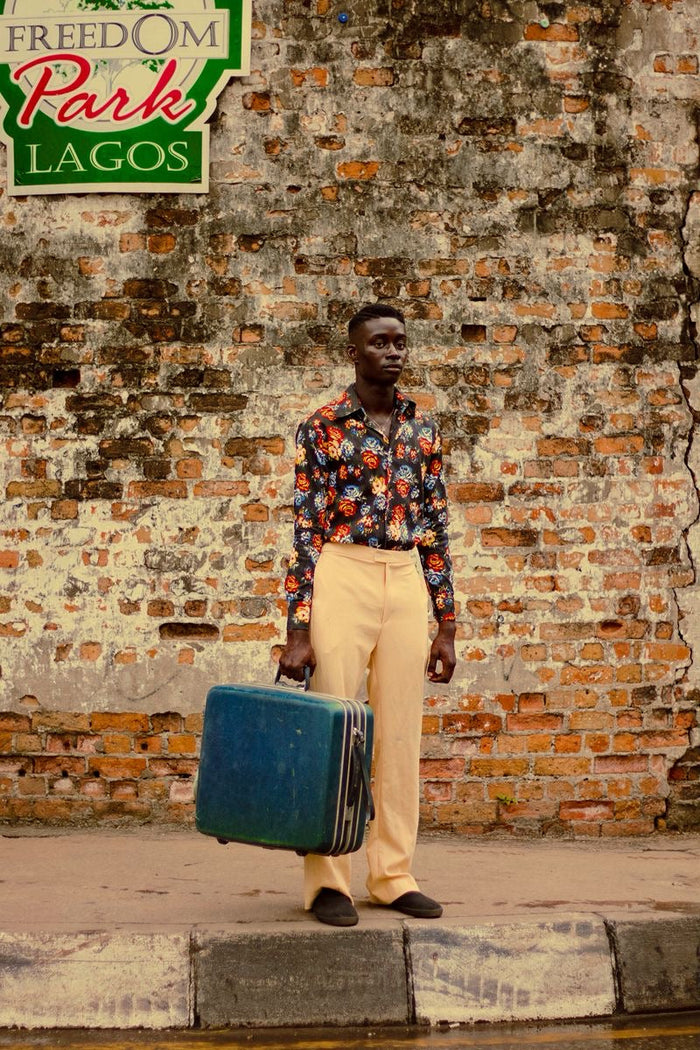
XCLUSIVE was built on this same conviction. That the clothes you wear carry meaning. That style is inheritance and argument and pleasure at once. That Lagos has always known how to dress with intention. That the art reshaping global fashion is not a new discovery — it is a long inheritance finally, fully, being seen on its own terms.
The source was always there. The question is who gets to tell the story.